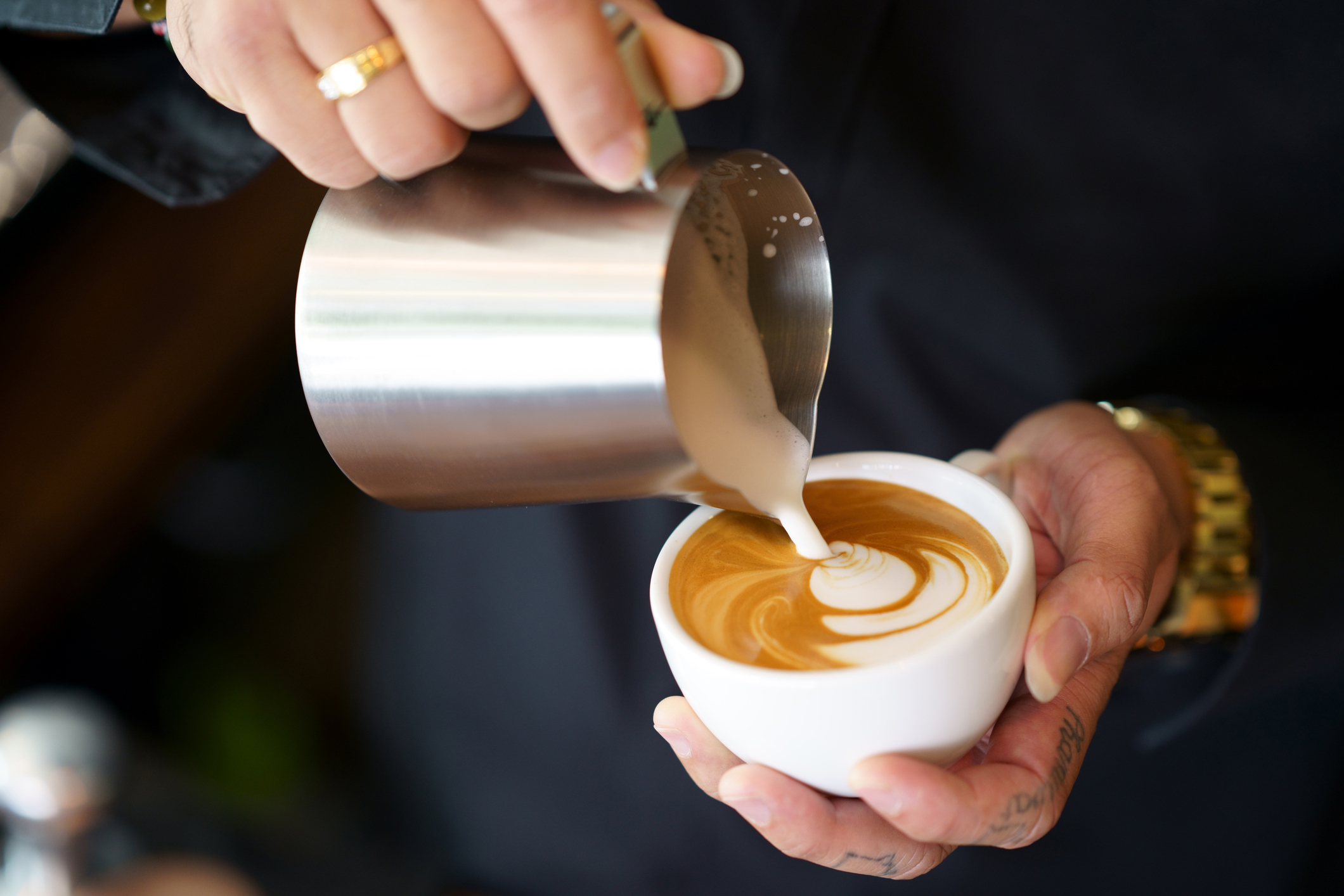
Interest in brew-at-home espresso has skyrocketed. The home espresso machine market will grow nearly 62% by 2035, according to Market Growth Reports. These machines allow you to create café-quality espresso beverages at home, something that most people never could have thought possible.
But with so many models, each at different price points and with different features, many people get overwhelmed about which machine to buy.
To help you make this decision, Bottom Line Personal spoke with Kyle Ramage, founder of Black & White Coffee Roasters and a previous World Barista Championship competitor. We asked what features you should avoid and which machines he recommends, from beginner models to the industry’s gold standards. His most important takeaway? “Find a brand that you know has a background in coffee.”
- Beginners: Breville Bambino
- Budding Home Baristas: Breville Barista Express Impress
- Passionate Hobbyists: Fellow Espresso Series 1
- Connoisseuers: Breville Oracle Dual Boiler
- Experts: La Marzocco Linea Mini
How to Choose the Right Home Espresso Machine
Choosing your espresso machine comes down to three main things—budget, experience level and space. Before you make a purchase, you should understand what you’re trying to achieve. Are you hoping to make beverages that rival your best local café…or do you just need an affordable machine to satisfy your need for a quick pick-me-up? Things to consider…
Budget
Like anybody, you’re probably concerned about price. But Ramage warns, “If you start out cheap…you’re going to have some really less-than-positive experiences.” The more affordable home espresso machines might be very challenging to use. In his opinion, the reduced functionality offers inconsistent quality.
Your experience level
Some machines are designed to be user-friendly. They simplify the espresso process with built-in components.
Super-automatic espresso machines do it all, from grinding and tamping (compressing the ground coffee into a uniform dense “puck”) to brewing and milk-frothing. They offer convenience and consistency so they’re great for people who know nothing about espresso.
Semi-automatic espresso machines balance usability with more control over the brewing process. You grind and tamp espresso beans yourself, while the machine automates the pressure and temperature control. These are ideal for people who want to take an active role in the espresso-making process, whether they’re just learning or have years of professional expertise.
The most expensive, higher-end models require experience. Ramage likens these machines to driving a race car—they are performance-based, not user-friendly and require knowledge about espresso extraction for the best results.
Space
If your counter space is limited, consider a compact espresso machine with a narrow profile for shallow counters. These generally fall into the super-automatic category. Semi-automatic and high-end machines tend to take up more room. Important: Measure and note the space you intend to use before purchasing a machine.
Espresso Machine Features That Matter
Ramage considers a few features to be more important than others. He recommends finding an espresso machine with a dedicated coffee-brewing boiler. Some systems have single boilers that brew espresso and also steam milk, but this can lead to temperature and shot inconsistency. Dedicated boilers brew the espresso independently.
Standalone grinders are required for machines that don’t have that function built-in. Ramage considers the grinder one of the most important considerations for serious espresso hobbyists. He calls it the “chef’s knife” of the barista. Rule of thumb: Your grinder should cost 50% of the cost of the espresso machine. Recommended coffee grinders: Fellow Opus or Opus 2, recently released, is an affordable option starting at $195. Mahlkonig X64 and Niche Zero are premium home coffee grinders starting around $550.
Features to avoid: If your budget allows, steer clear of all-in-one machines. “If you buy an espresso machine that also makes drip coffee, steams your milk and grinds your coffee beans, you’re going to get the worst of all possible choices,” he warns. “You’re going to get an awful batch brewer, an awful grinder and an awful espresso machine.”
Top 5 Home Espresso Machines (Expert Picks)
Narrowing down a specific espresso machine for your needs can be difficult. You’ll often find commonalities between brands with identical features, similar looks and possibly even the same price points.
Ramage suggests that you limit your options to brands that specialize in coffee. Many espresso machines are made by companies that also sell other types of kitchen appliances. “I would always stay away from brands that have a very broad portfolio,” he said. Based on his 20 years of experience, here are Ramage’s recommendations for five different espresso machines and who they’re best for…
Best for Beginners: Breville Bambino
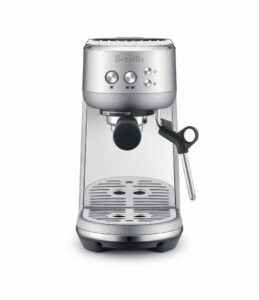
The Breville Bambino is the best beginner espresso machine on the market. Ramage says it’s a good entry-level option that lets you get into home espresso affordably. This budget-friendly model might lack the more advanced features and systems of higher-end machines, but it boasts a respected brand name in the espresso world.
Breville Bambino
Features…
- Simple single- and double-shot buttons for easy functionality.
- ThermoJet heating system that’s ready to brew in three seconds.
- Low-pressure pre-infusion (the process of soaking the coffee grounds for about two to eight seconds) and proportional-integral-derivative (PID) temperature control for balanced flavor.
- Manual ergonomic steam wand for microfoam.
- Footprint: 6.25 x 13.5 x 12 inches.
- Price: $299.95.
Best for Budding Home Baristas: Breville Barista Express Impress
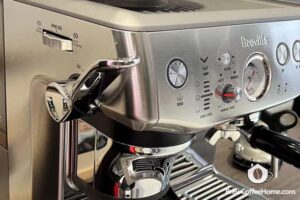
The Barista Impress line is a step up from the Bambino. This espresso machine and grinder bundle still incorporates simple, user-friendly functions, but it starts to creep into a more authentic espresso experience. This is Breville’s first “assisted” espresso machine that provides real-time guidance to the user, creating artisanal-quality espresso without the manual process typically required. It’s the best espresso machine under $1,000 on this list.
Breville Barista Express Impress
Features…
- Built-in grinder with intelligent dosing that learns from past outcomes.
- Various grind settings that adjust from slower to faster.
- Assisted tamping, providing a consistent 22 pounds of pressure for a perfect puck.
- Auto MilQ frother with calibrated settings for different kinds of milk.
- Footprint: 12.9 x 14.9 x 16.1 inches.
- Price: $799.95 to $899.95.
Best for Passionate Hobbyists: Fellow Espresso Series 1
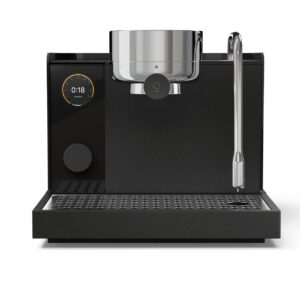
Fellow is newer to the espresso market, but as Ramage says, “It creates machines that can achieve a lot of the things espresso nerds want but are also aesthetically pleasing and affordable and usable for the rest of us.” The
Fellow Espresso Series 1
Series 1 is good for people who care about the specifics of espresso brewing but who may not want to invest in a professional-level machine. It provides preset options, as well as customizable settings for those who desire precision.
Features…
- Three-point heating system providing commercial-grade temperature stability.
- Adjustable dial for programming variables such as pre-infusion pressure, fill flow rate and duration.
- Temperature-sensing steam wand that automatically stops at your desired temperature.
- App connectivity for creating customized espresso profiles.
- Footprint: 17.24 x 12.4 x 10.98 inches.
- Price: Starting at $1,499.95.
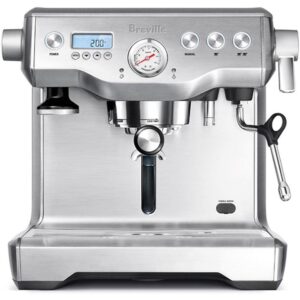
Best for Connoisseurs: Breville Oracle Dual Boiler
This espresso machine is the one that Ramage recommends for those who may not have specialty cafés nearby and who want to make café-quality drinks at home. It’s great for someone without a professional coffee background but still interested in more advanced espresso drinks.
Breville Oracle Dual Boiler
It’s a fully automatic espresso machine with a multisetting grinder, so the Oracle provides more precise shots than the previous machines on this list.
Features…
- Built-in grinder with 45 settings.
- Adjustable milk temperature from 115°F to 165°F with nine different texture settings.
- Manual and automated operation modes, with sensors to detect under- and over-extraction issues like a grind that is too course or too fine.
- Dual boiler system for simultaneous brewing and milk steaming.
- Footprint: 17.9 x 15.2 x 14.7 inches.
- Price: $2,999.95.
Best for Experts: La Marzocco Linea Mini
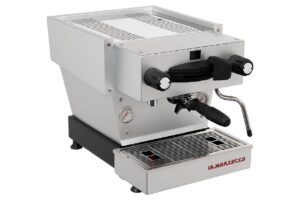
According to Ramage, the La Marzocco Linea Mini has been the gold standard of home espresso machines for more than a decade. It crosses into “prosumer” territory and provides the most authentic barista experience. Crafted in Italy, the Linea Mini is the smaller version of the Linea. Both are classic espresso machines used in thousands of cafés worldwide. It’s completely manual—there are no electronic presets, auto-adjust technology or built-in grinders.
La Marzocco Linea Mini
It’s raw, visceral and feels more like a machine than an appliance, but it produces undeniably good espresso.
Features…
- Dual boilers, PID temperature control and a rotary pump to provide consistent pressure.
- Manual pump pressure adjustment.
- Digital front-facing shot timer that ensures easy viewing for the same, accurate brew time for every shot.
- App connectivity for metrics, auto backflush and auto on/off times.
- Footprint:15 x 14.2 x 21.3 inches.
- Price: $6,600.
Tips for Getting the Most Out of Your Espresso Machine
Home espresso machines can be daunting to use in the beginning. Practice really is the key. Spend time with your new machine, and don’t be afraid to make mistakes. Adjust settings, change your processes and experiment to see what creates the best shot.
Important: Don’t skip cleaning and upkeep. For espresso machine maintenance, Ramage says to use high-quality water. “Water is crazy essential for coffee because it’s 98% of your beverage. Put filtered water in there—calcium builds up in these boilers over time, and they’ll eventually scale and fail.”
Bring the Café Home
The best home espresso machines range in price, functionality and features. Choose one based on your current needs and where you see yourself as a home barista down the road.
If you purchase from a reputable brand, grind quality beans and brew only with filtered water, you can enjoy café-quality beverages right in your own kitchen. Ramage says, “Now, the best coffee in any given city may actually be in some random guy or lady’s house.”